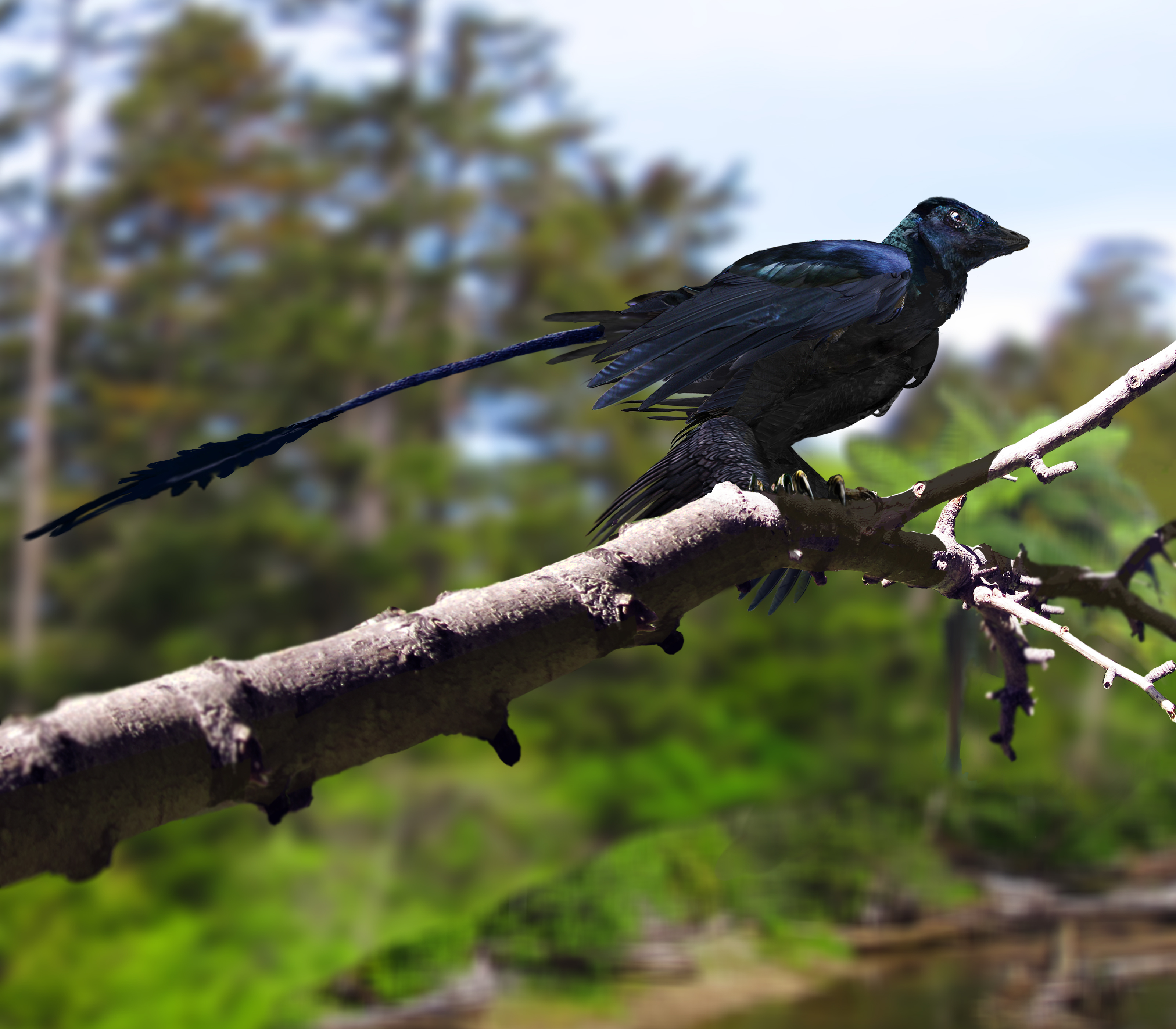
January – It is sunrise on a chilly morning in northeastern China, 125 million years ago. We are in an enormous forest on the edge of a system of lakes. The tree community here is diverse, with relatives of pine, cypress, cedar, yew, araucaria, podocarp, and ginkgo, among many others.About 15 meters up in the canopy a male Microraptor is roosting on a branch with his snout tucked under his wing and his long, feathered, tail coiled over his toes.
He is hunkered down against the chill in some thick cedar – like foliage. At first light he raises his head and opens his eyes. In the trees around him many species of birds and a few pterosaurs begin to call and flit about. Below, larger
dinosaurs roar and screech. From up here in the canopy we can see a dusting of snow on the volcano peak on the western horizon.
Microraptor rouses and begins to scale the trunk of his roosting tree. He uses the two large, hooked, talons on his second toes like climbing spikes. He has birdlike wings, but there are clawed thumbs and two long fingers that bend inward from the inner surface of each wing. He uses these to grip the bark. His climbing posture is quadrupedal.
When he reaches the crown of his tree he launches and glides for maximum range. He is scanning the sunny spots in the tree crowns closely. Each time he lands on a tree trunk or limb he climbs to the crown of the tree and launches again, soaring as long as he can with each leap. He is looking for lizards that are basking in the sun. They will still be sluggish on this cold morning. On a podocarp branch he spots the arboreal lizard Dalinghosaurus, tilted into the light with its eyes closed. Microraptor folds his wings and drops onto the lizard without hesitation. He lands on the lizard hard, and pins it with his needle -sharp second toe claws. He steadies himself against the impact by throwing his hands out and flapping at side branches covered with leaves. He seizes the lizard in his jaws and crushes the largest bones. He thrashes the carcass against the branch until it is pliable, and then swallows it whole. The extremely long and slender lizard tail protrudes from his jaws for hours.
February – The forest is dry. The ginkgos and czekanowskialans are just bare branches. Microraptor spends all of his time foraging. He takes whatever insects, centipedes, and spiders he can find, but they are scarce this time of year. When he finds persistent, unopened, cones on pine, araucarian, or spruce-like trees, he gnaws on them and tries to rip them open with the large claws on his fingers.
This takes a lot of work, but the seeds inside are rich in protein and fat. Microraptor also scratches off flakes of dry tree bark, scrounging for late stage cocoons, beetle pupae, and the egg cases of spiders and cockroaches.
On the hillside, a bolt of dry lightning strikes the leaf litter and starts a fire. As the smoky fire front moves downwind, it drives a surge of fleeing insects and small animals. Microraptor glides into a low tree near the edge of the fire and picks off grasshoppers, roaches, and beetles as they hurry past.
March – Microraptor cautiously alights very low in a shrubby bennetite at the lake edge. He observes a pod of the 7 – meter – long iguanodontid Jinzhousaurus browsing on ferns. Looking a bit like a tailless, beakless, nightjar, the frog – mouthed pterosaur
Jeholopterus zooms by, snapping up flies and water beetles. When Microraptor determines that the area is safe, he drops to the dried mud at the edge of the lake, and drinks warily. In the water we can see tiny, long-necked, hyphalosaurs sculling by. Confuciusornis plunges into the water to grab a fish, and then flies off like a kingfisher.
Spotting a dry, dusty, patch of ground, Microraptor lies down in the grit and grinds his feathers against it with all his body weight. He stands up and shakes out the dust like a wet dog. This is called anting, and it helps him to control lice and mites.
At sundown Microraptor is perched high in the crown of an araucarian snag when a movement below catches his eye. Nemicolopterus, the tiny forest pterosaur, has been snatching dragonflies and wasps from mid –air. It has a wingspan of just twenty-five centimeters
(less than ten inches). Now it has landed on a tree limb directly below Microraptor. Microraptor locks his eyes onto the pterosaur, and his pupils dilate with concentration. Carefully he gets into position, rocking his haunches like a cat. Then he leaps. He keeps his wings folded tightly, dropping straight down until the last split second. He unfurls his wings to break his fall, and pounces directly on to the pterosaur. Nemicolopterus startles and leaps away, but the pterosaur is snagged by a swipe from Microraptor’s finger claws, pulled back onto the branch, and quickly overpowered.
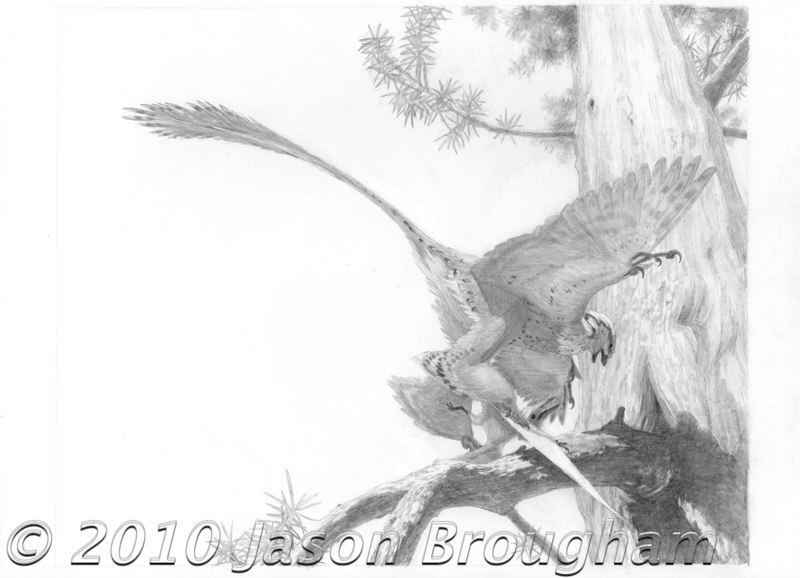
Later Microraptor regurgitates a pellet consisting of indigestible pterosaur fur and bones, just as owls do with rodent fur, teeth, and bones today.
April – Microraptor’s feathers begin to molt in a distinct pattern. The longest flight feathers of the tail, legs, and arms drop out in symmetrical pairs, one on either side of the body. When the replacement feathers and pin feathers come in they are wrapped in long, tubular sheaths. Microraptor must trim these sheaths off with his incisors, so he is constantly preening in April, and spitting out little flakes of sheath. He twists and turns, he scrapes his head against rough bark, and he pulls his tail feathers to his mouth with one hand, then the other. When the new feathers unfurl they are glossy and bright.
We can see stalks with clusters of tiny yellow flowers in the shallow water at the edges of the lakes, and there are flies buzzing around them. These are the first flowering plants.
May – The breeding season is beginning. At dawn and dusk Microraptor climbs to the highest point in a dead tree. He surveys the horizon, and there are several other males on similar perches. The males inflate the air sacs along their neck vertebrae and call at each other with loud rattles and squeaks. They raise a mane of feathers on their heads and necks that resemble those of the Philippine Eagle. Together, the feathers and air sacs make their heads look much larger.
Microraptor selects a small stand of trees from his normal foraging range and begins to defend them as a home territory. He glides around the outermost tree crowns of this territory throughout the day, and by doing this he sees and hears two neighboring males. Throughout the day he alternates between two perches where he can call loudly at each neighbor. Eventually he induces one of the
neighbors to move his home territory away to a more distant tree. The other male is larger and older, however, and he does not retreat.
The two males test the boundary by gliding to perches near each other, facing each other, and fanning out their wing and tail feathers. They hold their tails and heads up high in a threat display. They hiss, rattle and squeak. One afternoon they land so close to one another that a fight breaks out. They leap up and kick at each other with their second toe claws. The neighbor is knocked off the branch, but he breaks his fall with his wings and glides away. After this he moves his home territory further away. He keeps making territorial calls for weeks afterwards.
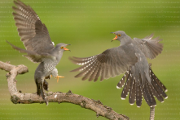
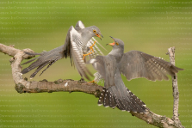
Territorial fighting in cuckoos (Cuculus).
On the forest floor, sawflies begin to hatch in the leaf litter and filter up to the canopy. The rains were good last year, and there are more sawflies than usual.
June – The first rainclouds of the year appear, and torrential rains fall. The streams and lake channels swell with water. The monsoon is here, and the rains are good again this year. Broods of nymphs in the lakes climb the stalks of horsetails to shed, and soon the forest is dotted with large, humming, mayflies. The air is filled with pterosaurs and birds gorging on them.
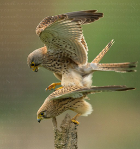
Microraptor is calling from a perch in a light rain. A female glides in to land on a branch near him. He climbs quickly along the branch toward her and she moves away from him. When she stops he keeps crawling all around her, even trying to pass her on branches and then circling back. He pursues her around the canopy like this for an hour or so. Later he calms down and the two begin to crawl around in the canopy together, hunting mayflies that have landed on the leaves.In a few days the male crouches down beside the female and pushes his head against her folded wing. She does not move. The male climbs onto her back, clinging to her rump with his toes. They copulate. She goes on feeding in his territory. Later another female enters his home territory, and the same sequence of events unfolds. Both females remain nearby. The male continues to call to the neighboring males.
Kestrels copulating in a light rain
By the end of the month the ginkgos and czekanowskialans are flush with bright green shoots and cones, and the ferns are loaded with fiddleheads. The forest is buzzing with cicadas and katydids. It is rustling with life.
July – The male now climbs down the trunk of one of his home trees, folds his wings, and walks awkwardly across the moist forest floor for the first time in nearly a year. He lifts his feet high and steps carefully to avoid scuffing the long flight feathers on his legs. The ground here is strongly sloped, and large tree roots are exposed. There is a ground cover of ferns that combines with the roots to form a low thicket. In a hollow between a clump of ferns and a large podocarp root, the male kicks away the wet, dead, leaves and pine needles until there is a bare, flat, patch of soil. The first female follows him to this spot and she lays two small, slender, spotted eggs on the soil. The male stops calling now and, in a few days, all the Microraptor males in the forest are silent. The male stays down here near the nest. He stands near the eggs but does not touch them. When it rains he spreads his wings and uses them like an umbrella to keep the eggs dry. When he hears a dinosaur passing on the forest floor he hunkers down in the ferns and holds still.
Most days from then on the first female lays two more eggs. In eight days her clutch is finished, 16 eggs in all. The second female begins laying in the nest a few days after the first. Now the clutch holds thirty eggs in total. The male’s behavior changes when he sees the completed clutch of eggs. He becomes aggressive toward the females. He raises his head and tail and displays at them. He charges at them and drives them away from the eggs. The hens go off to forage and recuperate. They have lost a large percentage of their former body weights and they are ravenously hungry.
Now the male sits on the eggs for the first time. He spreads his wings over them to cover every egg. He presses the two warm, featherless, patches of skin on his belly against them. The embryos in the eggs begin to develop as soon as he warms them to his body temperature. Though they were laid on different days they were delayed until the male began incubation. Now their development is synchronized, and they will all hatch on the same day.
When it is not raining the male leaves the clutch for an hour or so a day. He hunts out wood – eating cockroaches, stick insects, katydids, and beetles in or near the nest tree. From up in the branches he can sometimes see his nest below.
One day he is coming back from feeding and he lands on the trunk above the nest before climbing down. From here he spots a small dinosaur, a troodontid called Mei long, standing in the thicket near Microraptor’s nest. Mei is holding a crushed eggshell in its jaws. Microraptor drops down onto Mei with outstretched talons, but he fails to pin the troodontid. Mei shakes the dromaeosaur off and flees with a bleeding wound on its back. Microraptor chases Mei and snaps his jaws after it, but Mei is much faster, and escapes. Twenty-six eggs remain, unharmed.
He broods the eggs for four weeks.
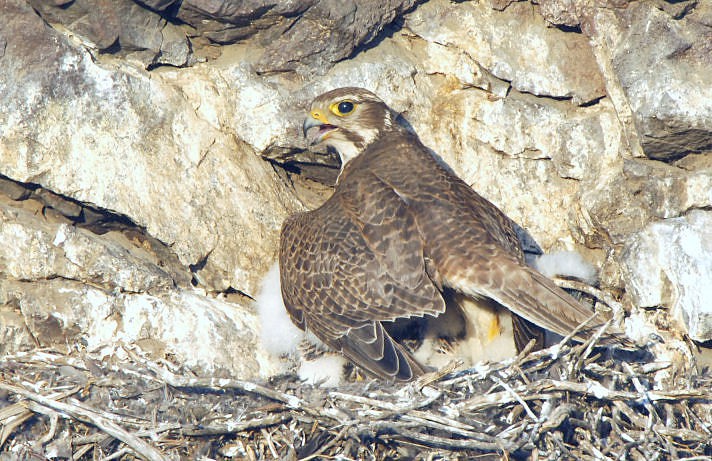
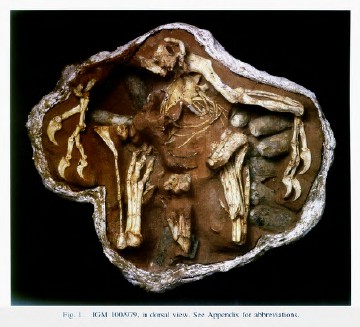
Two maniraptorans brooding their nests in the same posture – Falco peregrinus (extant) and Citipati osmolskae (70 million years ago)
August –The embryos begin to make clicks inside the egg. The chicks crack out of their eggs by kicking them open with their sharp toe claws. They have long wing feathers in sheaths on the arms, legs, and tail, but there is mottled down on their bodies and heads. They have comically large heads and tiny bodies with long, spindly, legs. They are extremely tiny, with heads and bodies just 5 centimeters (2 inches) long and feathered tails that double that length. After they open their eggshells they fill their lungs and the air sacs in their bones for the first
time. They lie still and breath for four hours. The father shelters them under his wings. The chicks begin to preen their feathers, by nipping off the sheaths with their sharp premaxillary teeth. Their feathers dry out and become fluffy. Their eyes open and they look up and see the Early Cretaceous sky for the first time.
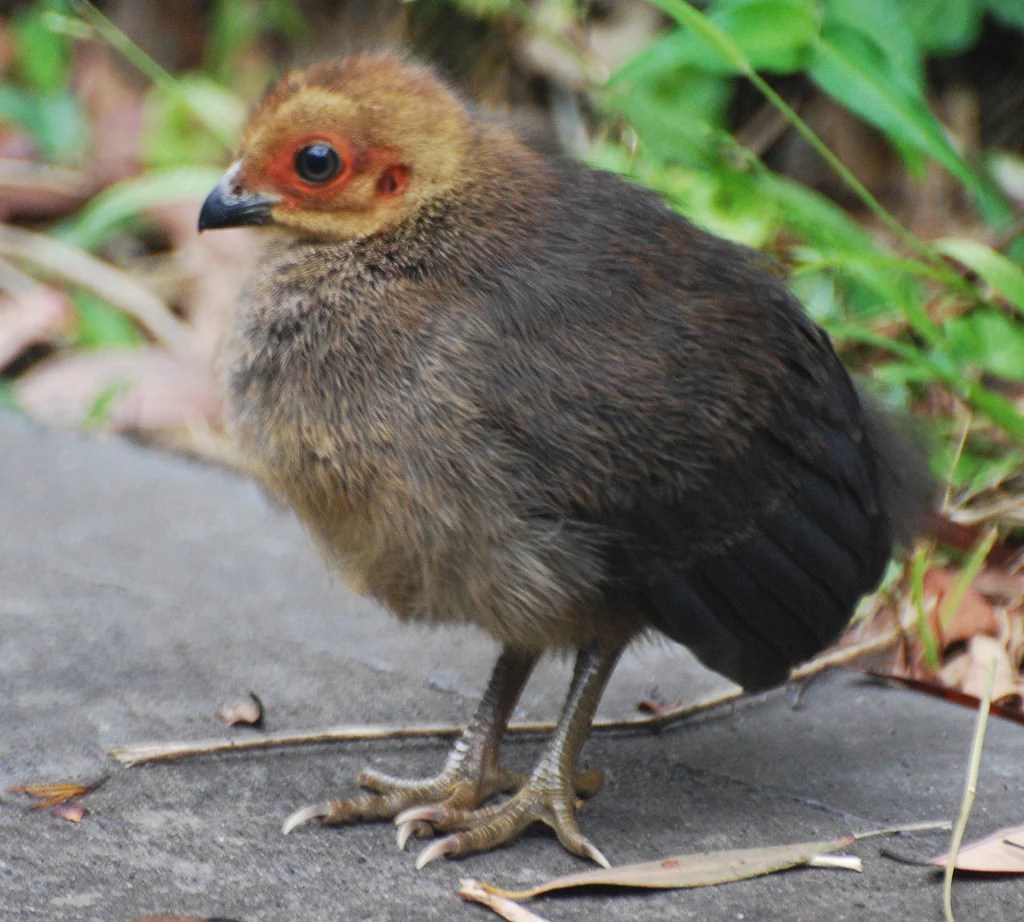
The father roosts in the nest with the hatchlings the first night, but they can already maintain their own body temperatures. The next day the chicks stand up. They begin to crawl around and flap their wings aimlessly. By now their chorioallantoic membranes have sloughed off. The male leaves the nest and scales the tree trunk near it. He pauses a meter or so up on the trunk and makes a low vibrato sound. Haltingly, unsteadily, the chicks wobble towards the trunk.Some begin to scratch their way up the rough bark with the needle – sharp claws on their fingers and toes. There are twenty-four live hatchlings in all. The male stops at the lowest bough and waits for all the chicks to climb up to him. They roost together with their father that night, huddling beside him and even climbing onto his back.
A superprecocial megapode chick
The next day the largest chick leaps from its branch, and sails twenty meters to a nearby tree trunk. The others gradually do the same, gliding or falling to random landing sites on their first clumsy sorties. They are so small and lightweight, and their four wings and tail provide such large parachutes, that even those that land in the leaf litter below are not injured. One hatchling glides especially far and crash-lands into a shrubby clump of Ephedrites on the forest floor. The motion attracts the attention of Sinosauropteryx, a striped dinosaur the size of a housecat. Sinosauropteryx darts over and seizes the hatchling in strong jaws. He thrashes the hatchling, and stamps it with his foot, then swallows it whole.
Sinosauropteryx remains in the area for a while, looking for more hatchlings. The other Microraptor hatchlings in the area hold perfectly still. The male watches Sinosauropteryx from a branch, but it is larger than him and he does not attack it.
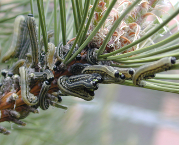
The other hatchlings go on foraging in their father’s territory. The pines and other conifers nearby support especially large colonies of sawfly larvae, looking like large masses of inchworms. The chicks gorge on these larvae without having to expend too much energy.
The father and chicks continue to roost together at nightfall.
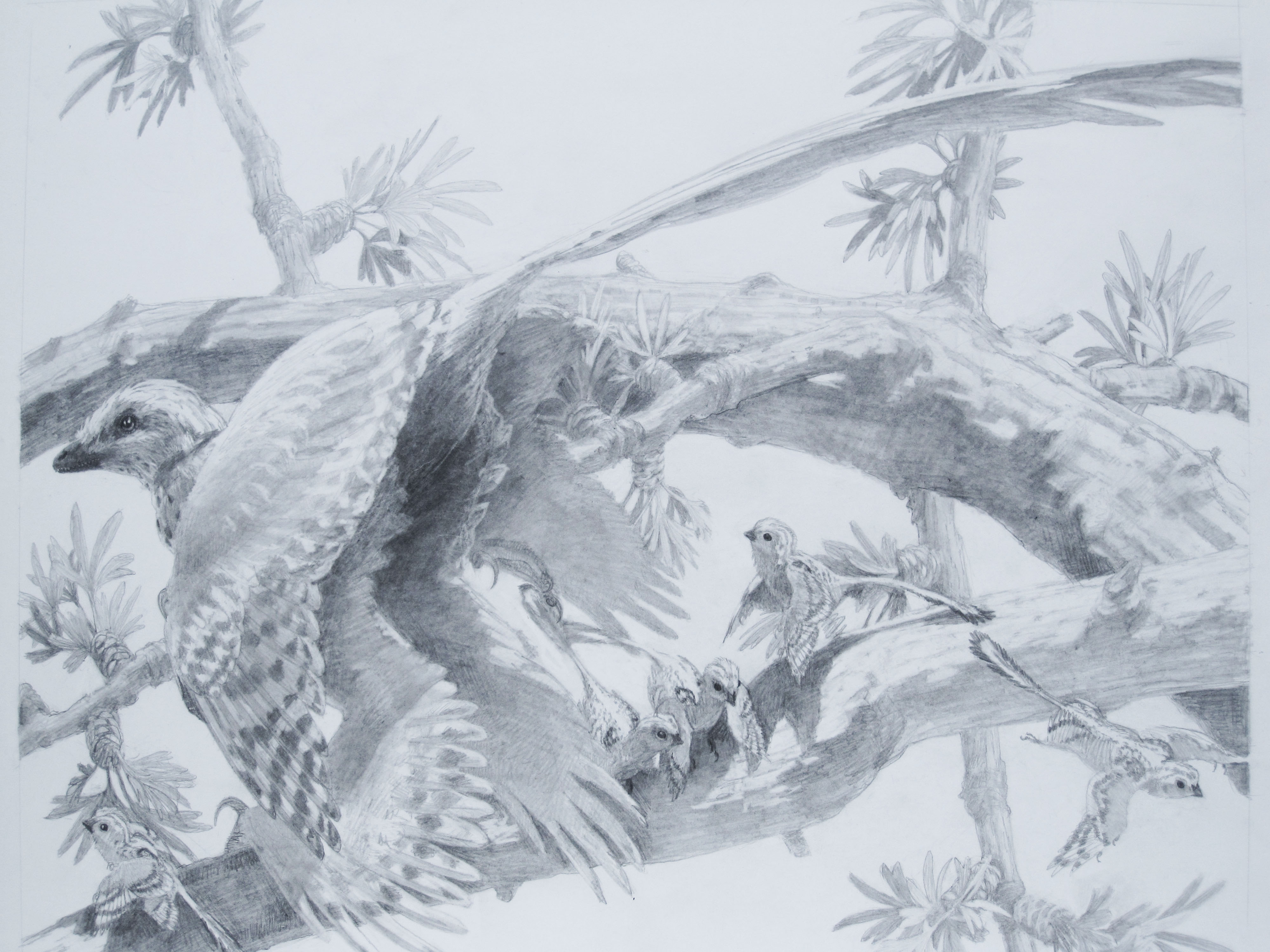
In primitive birds the father forages with the young, but does not feed them
September – The young are now competent gliders, and they glide with their father to foraging sites like a detachment of miniature fighter jets. Due to their geometrically lower wing loading, the young are more maneuverable and they have a longer glide range than the father.
The father glides onto the trunk of an old, gnarled ginkgo tree while foraging. There are cavities in the tree trunk where forest fires have burned out sections of bark and wood. The male Microraptor sees a movement: a white eggshell falls out of one fire cavity. The male crawls down to the cavity and attacks the sparrow–sized bird, Liaoningornis, that is nesting inside. Microraptor seizes the bird in his jaws and drags it out onto a large branch, where he dismembers it by scratching it apart with his second toe claws. He swallows the sections of the body, feathers and all. Some of Microraptor’s young come to investigate the cavity. They feed on the newly hatched nestling birds inside.
October – The Microraptor family has dispersed. The juveniles now forage alone, looking like tiny, twelve-centimeter (5 inch)-long miniatures of their parents.
There are red fruits on many of the trees. Adult and juvenile Microraptor feed on fleshy podocarp fructifications for many days when they ripen. The podocarp trees attract many birds as well, including Jeholornis, which is roughly the same
ize as Microraptor, and the much smaller, short – tailed, Liaoningornis.
Microcachrys, the podocarp fruit closest to Squamastrobus tigrensis of Early Cretaceous Patagonia.
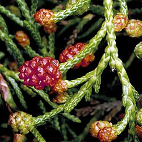
November – The Ginkgos and czekanowskialans turn to their yellow, orange, and scarlet fall colors and drop leaves. The fruits of some Ginkgos fall to the forest floor, where they are eaten by dinosaurs
such as Caudipteryx. Other species of ginkgo retain red, berry-like, fruits on their stems. These are taken by birds and Microraptor. The seeds of the ginkgos are dispersed in the droppings of the animals.
December – A female Microraptor from the brood now weighs nearly twice what she weighed when she hatched, yet she is still a tiny juvenile and only 15cm (6 inches) long. She is perched high in a bare Ginkgo with just a few withered fruits left attached. A motion on a limb below catches her attention. A tiny arboreal opossum, Sinodelphys, is gnawing into ginkgo seeds caught in a tree crotch.
Several juvenile Sinodelphys have ventured out with the adult, and they are the size of crickets. The female locks her eyes onto one juvenile that is furthest from the adult, and crawling up the tree bark. Carefully, Microraptor lines herself up, rocking her haunches just like her father. She leaps with her talons outstretched.
 softdinosaurs